
🎼 background music
The People
Thierry Wong
1 Cherish
2 Trudge
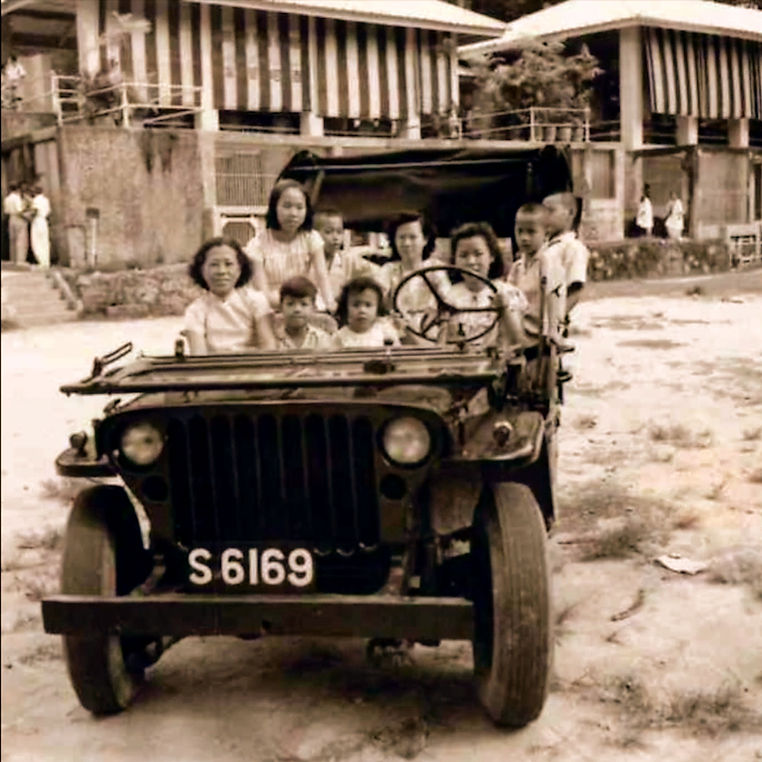
My Mother
Driving a Land Rover
1950s
1 Every day, she recited Tang and Song poetry, sang Cantonese opera karaoke in her own yard...…
"Mother just passed away this morning. No need to notify anyone else, just letting you know. You're busy, no need to come all the way here." Early in the morning, a message arrived on my phone.
I read it carefully several times, pondering the profound meaning, until the screen went dark...…
I looked up at the sky, took a breath. What appropriate response should I have?
M is a good friend I met in my youth, with his own personality and persistence in dealing with things. Like me, M's mother suffered from dementia. We rarely meet, only two or three times a year for small gatherings. We don't text each other often, but every time we meet, we don't need to warm up, bypassing the details and hitting the core! It was our shared cultural background that brought us together by chance, forming a special "support group." We both like reverse thinking, constantly playing the "opposition party" to make each other think more deeply.
Once, he questioned the rationality of giving medication to the patient. He said, "Dementia cannot be cured. The medication is only theoretically delaying the arrival of the terminal stage. So, what is the positive significance of taking the medication?"
I was speechless, we looked at each other for a full three minutes without saying a word.
If you think M is a cold-blooded animal, you are very wrong. For his mother with dementia, he resigned from his high-paying position in a large organization and found a leisurely job, working from home via video conferencing in the morning to take care of his mother; only returning to the company after lunch to chair work meetings. To pick up and drop off his mother for shopping or doctor's appointments, he changed his car to an SUV that was convenient for wheelchairs to get in and out of. To please his mother, he downloaded many Cantonese opera karaoke files online, rotating them every day for his mother's entertainment.
Once, I said to M, "I can't make decisions for others, but I respond to the government's call and won't use intubation when critically ill. I hope that by the time I'm old, Singapore will have accepted euthanasia."
M immediately replied, "You are not a fish."
What do you mean, "You are not a fish?"
In addition to dementia, M's mother also suffered from diabetes and had respiratory problems. But every morning, she would get up and loudly recite Tang and Song poetry in her own yard, and then sing Cantonese opera karaoke with great energy. How can you determine that her life is unhappy and without quality?
Again, I was speechless.
How can dementia patients choose for themselves? How dare others make the decision to give up life for patients?
M said, "The ancient saying tells us to do our best."
Every time I see M, I have new learning. He is not aggressive, but very calm and composed.
2. Keyword: Magical
Some things, the other person can say, but I can also choose not to listen.
Alone, I went to the funeral home.
M was dressed in plain clothes, without excessive grief, his expression as usual, relaxed and natural.
At the wake, we talked about end-of-life care. The mother, suffering from diabetes, had skin erosion, and bones were exposed one by one. Later, they became brittle and fell off little by little. Magically, the skin wrapped the bones again, and the skin healed. But soon, the skin rotted again, the bones were exposed again, and fell off again...…
I noticed that the adjective M used was "magical." I felt goosebumps and discomfort all over. How did he learn to take care of her?
Pressed hard, M finally replied that he was just as timid and afraid when the bones fell off. Every day on the way home from work, he was always worried about what new situation would happen.
From M's eyes, I heard his inner fragility.
When saying goodbye, I held M's hand, speechless.
M, graduated...…
3 "Can the hospital-style bed and wheelchair be used?"
A week later, M sent me a message saying that he had left three boxes of diapers for me. He also asked: Can the hospital-style bed and wheelchair be used?
I said that the bed couldn't be used, but I would help ask around. I would buy the wheelchair from him.
M replied that he would arrange for the wheelchair to be delivered next week.
M is an impatient person, doing everything quickly and decisively, without ambiguity or dragging.
I replied that there was no need to be so urgent.
M said that he wanted to tidy up the house and let his family have a new beginning as soon as possible.
I reminded him that he should give the family some time to mourn and adjust their mood, and that tidying up the belongings should wait until at least three weeks after the passing.
Ten seconds later, M sent me a thumbs up.
4 This crutch of mine might suddenly break in two with a snap
On New Year's Eve, we had a sumptuous reunion dinner at a restaurant. Crab, abalone, chicken, meatballs, tofu, and vegetables were all available. It was rare for my picky mother to be satisfied, without nagging, and another hurdle was crossed.
"Spring Festival Gala"...…
"Red envelope, how much money are you going to give?" My mother saw the red envelope and asked to get to the bottom of it. I understood my mother's concerns; too much, we can't afford it. Too little, and she worries about owing others too much. I hesitated, calculating how to answer. In recent years, the job of giving red envelopes has been transferred to me. Although it's not her private money being used, the red envelopes are still given out from her hand. Psychologically, she has never gotten rid of the psychological pressure of money.
"I'm asking you, how much money are you giving in the red envelopes?" From her voice, I could tell that my mother was getting angry.
"What do you think? How much should we put in?" I replied cautiously.
"When you were young, wasn't it two cents? Or simply two peanuts. Later, it rose to two dollars. How much does a meal cost at a coffee shop outside now?" My mother hasn't been to the market for many years and is out of touch with the price situation.
"A cup of coffee is one dollar and twenty cents, a bowl of noodles is three and a half dollars." I replied.
"So, giving people two dollars won't even buy a bowl of noodles."
"Then we'll give twelve dollars, okay?" I followed her lead.
"Six dollars is enough. We have to spend a lot of money for the New Year." The family is big, my mother is of a high generation, the siblings have branched out, and there are many relatives. The New Year is indeed an expense.
"It's okay, it's only once a year."
"They don't usually come around, but they come to beg for red envelopes like beggars during the New Year."
"When they come, I also earn their red envelopes. I don't even have to go out," I tried to lead her to think positively.
"You're alone, but they come with kids ."
"If we don't celebrate the New Year, then we'll be even less likely to see each other."
"Then wait until the day of my funeral."
Listening to this, I couldn't help but feel sad.
"Look at the acrobatics performance on TV. Amazing!" I finally caught an opportunity to divert my mother's attention, stood up, and prepared to change the subject.
"What's so good about it? Have you prepared the red envelopes?"
"Yes, I'll give them to you tomorrow when we give them out."
"Oh, why not now?" My mother's thinking is still very clear when responding on the spot, but her "mid-term memory" is blurred.
"There are many bad people during the New Year, it's safer for me to keep them," I perfunctorily replied, recalling last year's farce in my mind, when my mother locked the red envelopes in the drawer, but didn't know where she had hidden the key when the New Year's guests visited. I didn't want history to repeat itself...…
If traditional festivals don't keep pace with the times and adapt to local conditions, they will become a kind of oppression. Young people can rebel wantonly, but on my mother, who is used to enduring, I clearly see the ravages of traditional etiquette. As a single person living under the same roof as my mother, I am destined to be a crutch beside my mother, accompanying her as she stops and goes, and also having to bear her emotional outbursts. As we both age and our physical strength declines, the sense of oppression increases. I often think: this crutch of mine might suddenly break in two with a snap.
5 Mother realized I had slipped out and wanted to "check the room"?
Perhaps due to the physical and psychological fatigue before the New Year, my mother went back to her room to sleep before ten o'clock.
Liberated! - I cheered in my heart.
"Hey! I'll be your follower tonight, let's go for a drive." H has been going to temples to offer incense and pray for blessings during the New Year for thirty years. Once upon a time, the "Spring Festival Gala" became a soft promotion of Chinese national policy, using the leisure of the people during the festival to brainwash them through lively programs. The TV programs were boring, so I gave H a call...…
At eleven o'clock, I changed my clothes and followed H to visit temples all over the island. I was curious about this folk custom, but I never had the opportunity to participate. This year, we have a helper at home. So I, like a horse freed from its reins, regained my freedom. Going out actually has little to do with religious appeals.
H drove, selecting a temple in each direction, east, south, west, and north, and sincerely offered incense. Each place was filled with incense smoke, a hazy scene. I followed suit, raised the incense sticks, and silently prayed and blessed the gods. I hoped that my mother would complete her last journey with magnanimity, and that the gods would give me the power and wisdom to adapt to circumstances.
When I got home, it was already two in the morning. After washing up, I fell asleep.
In my sleep, I vaguely heard the helper muttering to herself outside the door. What the hell! Did she eat too much New Year's Eve dinner and was having a nightmare?
Five minutes later, the mumbling hadn't stopped. So, I propped up my tired body and went to take a look.
When I got to the living room, I was shocked, as exaggerated as it could be!
My mother's head and face were covered in blood, her sleeping gown was stained with blood, and there were pools of blood on the floor. My mother fell to the ground, and her crutch was overturned to the side. The helper was crying all the time, at a loss.
I was frightened by the scene in front of me, but in the next second, I regained my composure and leaned forward to check the wound. I asked my mother a few questions -
"How many fingers am I holding up?"
"Can you raise your hand high, can you move it?"
"Which part of your body feels pain?"
Preliminary judgment, it was a skin injury, her head hit the door frame.
Without thinking, I stopped the bleeding first. I asked the helper to help my mother into the shower to clean the wound, and I hurriedly rummaged through the medicine box, pulling out the blue medicine, cotton, and gauze. After helping my mother change into clean clothes, I dabbed on the blue medicine and pressed the wound tightly. Fortunately, the bleeding stopped in less than five minutes. I breathed a sigh of relief, no need to call an ambulance to send her to the hospital.
...…
"During the festival, the gods are too busy, otherwise, how could they not have heard my previous prayers? Are they punishing me for not worshiping devoutly enough?" Complaining aside, I went into the room and propped up my pillow to do a rational analysis: Why did my mother fall? Why was she facing the front door when she fell? Was it over-fatigue, loss of sense of direction, and she hit her head on the door frame? Or did my mother realize that I had slipped out, couldn't sleep peacefully, and wanted to "check the room" to find out?
Thinking about it, I couldn't help but feel a little guilty.
6 If the patient has a dream, there is no need to wake her up, accompany her, and help her fulfil her dream.
The next day, I went to check on her. My mother was lying quietly, a small patch of red bloodstain on the pillow, indicating that the wound had not yet healed. On the first day of the new year, ordinary clinic doctors don't work, so going to the hospital emergency clinic was inevitable. So, I hired a car and came to the emergency department of Tan Tock Seng Hospital.
After completing the registration procedures, the nurses quickly did a simple bandage. An hour later, I saw the doctor, who said: stitches must be done, followed by a scan, and then observation in the hospital.
The doctor gave the patient local anaesthesia and then began to stitch.
Considering my mother's dementia, the medical staff allowed me to stay in the operating room to reassure her.
"Don't do the surgery, let me go home!" With each stitch, my mother screamed hoarsely, waving her hands wildly, struggling strongly, and shouting not to continue.
I stood aside, pressing my mother's hand hard, talking to comfort her, distracting her attention, and preventing her struggle from affecting the operation.
"Wasn't anaesthesia injected?" I asked the doctor.
The doctor explained that my mother's screams were a subconscious reaction, not a real feeling of pain in the physiological nerves.
The nurse chimed in, saying that my mother could feel the needle and thread running through her muscles, but it wasn't pain.
Screaming is not a reaction to pain, a novel concept! So, what about silence? Could silence also be a kind of forbearance of pain?
"I don't want it, I don't want it!" My mother continued to scream at the top of her lungs. For a moment, I was filled with mixed feelings. When I was a child, my mother was always taking care of the frightened baby, and now we have exchanged positions.
In the ward, I thought of M. Facing difficulties, he was timid, but at that time he could only pretend to be calm. Today, I am playing the role that M played back then.
And my mother, when she looked at the child who was causing trouble, was she also helpless, terrified, and afraid? However, she could only endure it. Is this revenge? Or is it retribution?
Wild horses will be tamed, children will grow up and mature, but dementia patients are constantly declining and decaying. Facing cause and effect, even God is powerless.
For people with dementia, all one can do is accompany them silently. God is probably the same. How do people grow up? It is in the endless bumps and bruises. I suddenly thought of a public service advertisement that was broadcast on TV not long ago, in which a young man accompanied a dementia patient to feed chickens together. In reality, there are no chickens, the chickens are the old man's illusion. If the patient has a dream, there is no need to wake her up, accompany her, and help her fulfil her dream. However, not all companionship can be so easy in reality.
What is companionship? A kind of magnetic field, a kind of stability.
7 The "latent" mother was "awakened"
"Please come to the hospital as soon as possible, your mother has been making a fuss all night." At seven o'clock in the morning, I received a call from the hospital.
When I arrived at the emergency ward for observation, I saw my mother's figure through the glass door. She was trying to open the door.
My mother looked haggard, and the helper behind her also had dull eyes.
As soon as my mother saw me, she begged, "Let's go home, I want to sleep."
I glanced at her and said calmly, "If you want to go home, you have to take off the hospital clothes first."
"Why?"
"These clothes belong to the hospital. You have to wear your own clothes to leave the hospital."
My mother believed my specious reason and obediently followed the helper to change her clothes.
Taking advantage of this gap, the nurse at the counter told me that my mother hadn't slept all night, and kept insisting that this wasn't her home and that she had to go home because her child was waiting for her at home. The Filipino nurse vividly recounted the story, and I was sceptical because my mother never spoke English. My mother always said that she got high scores in all subjects during her student days, except for English, which was poor.
"Yes! She understands English." The nurse protested and continued to complain, "If she's not allowed to go home, she won't give up, hitting her head against the wall, and even punching and kicking the nurses. In the end, she had to be injected with two doses of sedatives......" My mother speaks English? Has she been "latent" for most of her life? Or was it a moment of quick wit, and she finally found a chance to avenge her past shame at the last minute?
"Now, let me take her home," I said.
The nurse said that according to the usual practice, the discharge notice would not be issued until eleven o'clock after the doctor's rounds.
"Why are there so many rules? Haven't you completed the scans and observations that you need to do? Staying here will only add to the chaos. Isn't that right?" I retorted.
The nurse stared blankly at my strength, perhaps surprised to see that I also inherited my mother's stubbornness. Finally, she nodded and agreed to deal with it as soon as possible.
When dealing with dementia patients, rules are useless. The key is to cleverly find a reasonable prescription to avoid negative emotions and resolve conflicts that are harmful to both sides.
8 The "Support Group" Dissolves
On the sixth day after my mother's discharge, I asked M to come over to remove her stitches, saving the trouble of waiting at the hospital.
M gladly accepted. Upon seeing my mother, he immediately greeted her in Cantonese: "Auntie, what happened to your head?"
"What happened to my head?" My mother was completely bewildered.
"You went to the hospital and had nine stitches on the first day of the new year, right?"
"Did I?"
"Take a look in the mirror."
The helper handed over a mirror. My mother touched the large "centipede" crawling across her forehead and grinned. "Oh, such a big deal, how come I have no memory of it at all?"
"Auntie, I'll remove the stitches for you now, okay?"
...…
After removing the stitches, to express my gratitude, I invited M to a nearby small restaurant to nourish his stomach.
I asked M if he had any new focus in life.
M said that in the coming years, he would give his work even greater challenges.
I really wanted to ask M what experiences he could share about accompanying his mother in her later years. But on second thought, it was a meaningless question. Every dementia patient will develop different behaviours based on their own personality and experiences in their youth. There can be no standard answer.
After the meal, M insisted on paying the bill.
I was a little disappointed, not because I couldn't get the chance to thank him, but because I realized that it was time for our "support group" to disband.
Outside the restaurant, the sky suddenly poured down rain. M detoured, insisting on giving me a ride home. The windshield wipers in front swiped rhythmically, protesting against the fierce attack of the raindrops.
I was home. No matter how heavy the rain, I couldn't stay in the car forever. I jumped out of the car and rushed into the house...…
9 "It's nothing, don't scare yourself!"
Inside the house, my mother was standing on a high stool, one hand pulling on the window railing, the other rearranging the New Year decorations on the window.
The helper couldn't stop her and could only nervously stand by as a protector.
I shouted like an ant on a hot pot: "Come down quickly! It's dangerous."
My mother replied casually: "I've been doing this for thirty years, it's nothing, don't scare yourself!"


